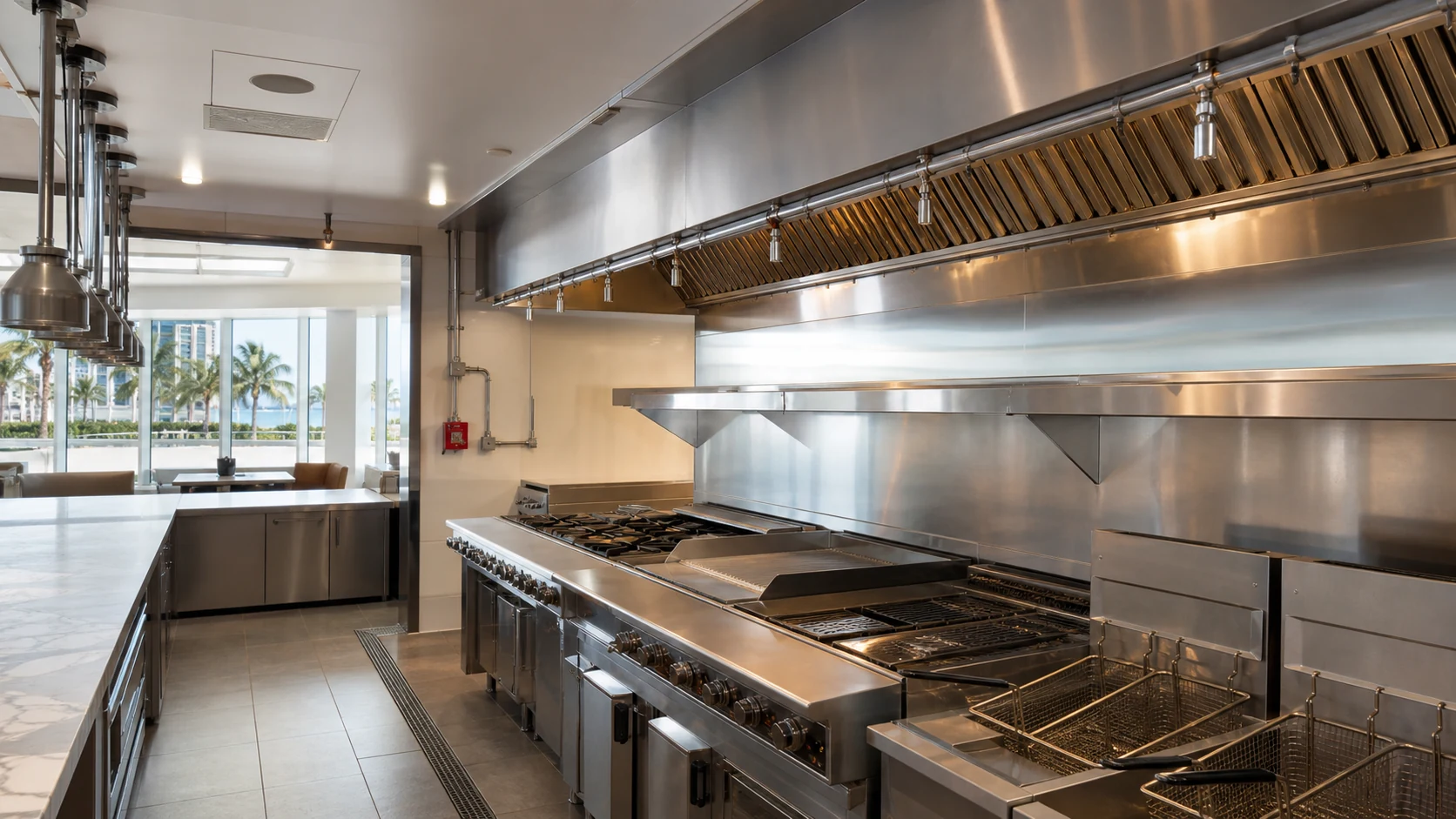
Kitchen Hood Fire Suppression Inspections in Palm Beach County
Kitchen Hood Fire Suppression Palm Beach performs recurring inspections for fixed fire suppression systems protecting Palm Beach County commercial cooking equipment. Request service when the six-month date is approaching, the current tag appears overdue, records are missing, or an inspection has been requested by a property manager, insurer, franchisor, or authority. This service evaluates the kitchen fire protection system and protected appliance arrangement. It does not clean the exhaust system or replace a government inspection.
What a Kitchen Fire Suppression Inspection May Address
Depending on the installed system and confirmed scope, an inspection may address accessible detection and actuation equipment, wet-chemical agent storage, distribution piping, discharge nozzles, nozzle caps, manual pull stations, and applicable fuel or electrical shutdown functions. The protected commercial cooking appliances beneath the hood are important context because equipment changes can affect the protected hazard.
- Wet-chemical agent storage may be reviewed as part of the installed system and confirmed inspection scope.
- Accessible detection equipment may be considered, includingheat-responsive detection componentswhen present on the installed equipment.
- Distribution piping, discharge nozzles, and nozzle caps may be reviewed in relation to the protected appliance arrangement.
- The manual pull station and reasonable access to it may be part of the inspection scope.
- Applicable fuel or electrical shutdown functions may be addressed when included with the installed system.
- The inspection focuses on fixed fire-extinguishing equipment protecting commercial cooking appliances.
- Available service tags, prior reports, and deficiency notices can help clarify the system history and current request.
The appliance line should be considered with the kitchen fire protection system. A fryer, griddle, charbroiler, or other appliance change can affect the protected hazard and may require a follow-up service scope. If a problem requires parts, manufacturer-specific procedures, additional access, modification, or separate corrective work, that work may need to be scheduled separately.
Not sure when the system was last serviced? Provide available records, photographs of the service tag, and the complete appliance line when requesting an inspection.
Request an InspectionKitchen Fire Suppression Service Is Not Hood Cleaning
A kitchen fire suppression inspection addresses fixed fire-extinguishing equipment. Hood cleaning removes grease from the exhaust hood, filters, plenum, ducts, and fan. These services address different equipment and require separate records.
Semiannual Service
Commercial cooking fire-extinguishing systems in Palm Beach County are generally inspected and maintained at least every six months under requirements commonly applied to this equipment. The installed system, currently adopted requirements, and applicable authority should be considered when confirming the exact schedule.
System-Specific Scope
The installed system and its procedures help determine the applicable inspection scope. Customers may encounter references to NFPA 17A or NFPA 96 in fire suppression system records or review requests.
Records and Follow-Up
An inspection does not promise a deficiency-free result. When a condition needs correction, parts, manufacturer-specific procedures, additional access, modification, or separate corrective work, a follow-up service scope may be needed.
Appliance Changes
Fusible links or other heat-responsive detection components may be present depending on the installed equipment. Changes to appliances beneath the hood should be identified when requesting service.
Fire suppression inspection and hood cleaning are separate services. Each addresses different equipment and should be documented with the appropriate records.
Changed an appliance since the last visit? Include that detail with the inspection request because the protected cooking arrangement provides essential context.
Request a Coverage ReviewWhy the Six-Month Date Matters
Recurring kitchen fire suppression service helps customers address an approaching six-month date, an overdue tag, missing records, or an inspection request from a property manager, insurer, franchisor, or authority. Confirming the installed system, currently adopted requirements, and applicable authority helps establish the appropriate schedule and scope.
Current Tag Date
The current service tag date is useful information when requesting recurring inspection and maintenance service for a commercial kitchen fire suppression system.
Protected Appliance Line
The commercial cooking appliances beneath the hood provide essential context. Report appliance changes and provide a photograph of the complete line when possible.
Reasonable Access
Arrange reasonable access to the hood area, fire suppression system equipment, manual pull station, and relevant utility-shutoff locations before the scheduled inspection.
Available Documentation
Provide the kitchen address, site contact, current tag date, prior report, and any deficiency notice. Those records help clarify the service request and system history.
Kitchen Fire Suppression Inspection in Palm Beach County
Kitchen Hood Fire Suppression Palm Beach performs recurring inspections for fixed fire suppression systems protecting Palm Beach County commercial cooking equipment. Restaurants, hotels, schools, healthcare facilities, clubs, commissaries, and multi-location operators should identify each protected cooking area independently when requesting service.
West Palm Beach
West Palm Beach commercial kitchens can request recurring kitchen fire suppression inspection service and provide current tag information, available reports, and appliance-line details.
View area →Palm Beach
Palm Beach commercial kitchens can request service for an approaching six-month date, overdue tag, missing records, or a requested inspection.
View area →Boca Raton
Boca Raton kitchens can request recurring fire suppression inspection service and share the kitchen address, site contact, and available system records.
View area →Delray Beach
Delray Beach commercial kitchens can prepare for inspection by arranging reasonable access to the hood area, system equipment, manual pull station, and relevant utility-shutoff locations.
View area →Boynton Beach
Boynton Beach customers can provide photographs of the service tag and complete appliance line to help clarify an inspection request before scheduling.
View area →Palm Beach Gardens
Palm Beach Gardens kitchens can request recurring inspection and maintenance service for fixed fire suppression systems protecting commercial cooking equipment.
View area →Kitchen Hood Fire Suppression Inspection FAQs
Customers may encounter references to NFPA 17A or NFPA 96 in fire suppression system records or review requests. Those references do not replace confirmation of the currently adopted requirements, installed system procedures, and expectations of the applicable authority.
Request a Kitchen Fire Suppression Inspection
Request recurring inspection and maintenance service when the six-month date is approaching, the tag appears overdue, records are missing, or an inspection has been requested. Include the kitchen address, site contact, current tag date, prior report, deficiency notice, appliance changes, and photographs of the service tag and complete appliance line when available.